
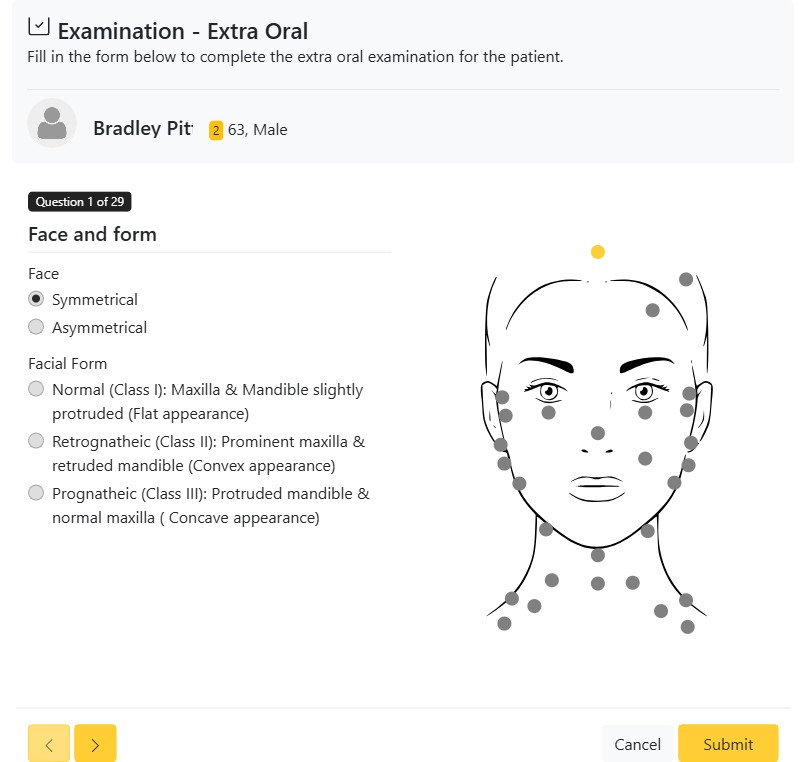
The Extra Oral examination is a structured head-and-neck screening that CAPS28 walks you through one region at a time — 29 steps in all. It is designed so that a full extra-oral assessment, including the kind of soft-tissue and lymph-node check that supports early detection of pathology, can be completed consistently every time without relying on memory.
What the Extra Oral examination covers
Each step focuses on a single structure and offers quick options (most default to Normal) so you can move fast and only stop where there is a finding. Regions include:
- Face and form — symmetry (Symmetrical / Asymmetrical) and facial profile (Class I normal, Class II retrognathic, Class III prognathic).
- Hair — Normal, Thin or Thick.
- Ears (left and right) — Normal, developmental defects, developmental pits, tissue tags near the tragus, inflammation.
- Nose — Normal, Saddled, Cleft.
- Salivary glands — left and right parotid, plus other glands: Normal, Numb or Enlarged.
- Thyroid gland — Normal, Numb or Enlarged.
- Temporomandibular joint (TMJ), lymph nodes and the remaining head-and-neck structures — each screened in turn through the guided steps.
How the step-by-step flow works
A badge at the top of each step shows your position — for example “Question 3 of 29” — followed by the region name and a short instruction. You choose the appropriate option or type a description, then advance to the next region. Because every structure defaults to a normal state, a clean examination is a matter of confirming and moving on; anything abnormal is captured in the clinician’s own words. When you reach the end and save, the completed Extra Oral examination is filed on the Examinations tab with the date and your name, and can be downloaded as a PDF.
Tips
- Work through the regions in order rather than skipping — the flow mirrors a systematic clinical examination.
- Describe anomalies precisely (site, size, character); the PDF becomes part of the patient’s permanent record.
- Pair the Extra Oral with an Intra Oral examination for a complete soft-tissue screen.